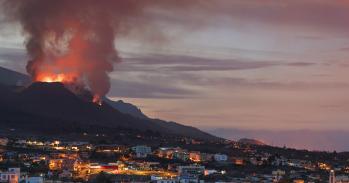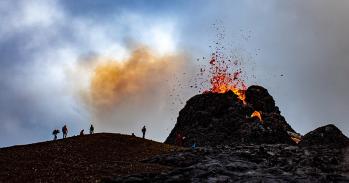
A team of researchers from Cambridge’s Department of Earth Sciences have recently returned from Iceland where, thanks to a bit of luck, they have gathered the most extensive dataset ever from a volcanic eruption, which will likely yield considerable new insights into how molten rock moves underground, and whether or not it erupts.
A team of researchers from Cambridge’s Department of Earth Sciences have recently returned from Iceland where, thanks to a bit of luck, they have gathered the most extensive dataset ever from a volcanic eruption, which will likely yield considerable new insights into how molten rock moves underground, and whether or not it erupts.
The team, led by Professor Bob White, has been monitoring activity near the Bárðarbunga and Holuhraun volcanoes since 2006, using up to 70 broadband seismometers.
Luckily, the seismometers and field researchers were still in Iceland at the time that this most recent volcanic activity began, as the team had recently finished recovering 25 seismometers from the Vatnajökull ice cap where they had been used for a study of small quakes caused by ice cracking.
Here, White and PhD student Tim Greenfield discuss their work, and what it’s like to be up close to such a spectacular eruption.
The text in this work is licensed under a Creative Commons Licence. If you use this content on your site please link back to this page. For image rights, please see the credits associated with each individual image.