Sorry, you need to enable JavaScript to visit this website.
Skip to main content
University of Cambridge
  • Study at Cambridge
  • About the University
  • Research at Cambridge
Quick links
  • For Cambridge students
  • For staff
  • For alumni
  • For our researchers
  • Business and enterprise
  • Colleges and Departments
  • Give to Cambridge
  • Libraries
  • Museums and collections
Home
  • Study at Cambridge
  • Undergraduate
    • Undergraduate courses
    • Applying
    • Events and open days
    • Fees and finance
  • Postgraduate
    • Postgraduate courses
    • How to apply
    • Postgraduate events
    • Fees and funding
  • International students
  • Continuing education
  • Lifelong learning
  • Courses in education
  • About the University
  • How the University and Colleges work
  • Term dates and calendars
  • History
  • Map
  • Visiting the University
  • News
  • Annual reports
  • A global university
  • Equality and diversity
  • Events
  • Public engagement
  • Jobs
  • Give to Cambridge
  • Research at Cambridge
  • For Cambridge students
  • For staff
  • For alumni
  • For our researchers
  • Business and enterprise
  • Colleges and Departments
  • Give to Cambridge
  • Libraries
  • Museums and collections

Breadcrumb

  • Home
  • optics

optics Subscribe to RSS - optics

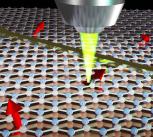
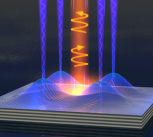
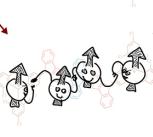
Artist's impression of aligned spins in an organic semiconductor

Switching ‘spin’ on and off (and up and down) in quantum materials at room temperature

16 Aug 2023
Researchers have found a way to control the interaction of light and quantum ‘spin’ in organic semiconductors, that works even at room temperature.

Read more
Abstract image

Researchers devise a new path toward ‘quantum light’

02 Feb 2023
Researchers have theorised a new mechanism to generate high-energy ‘quantum light’, which could be used to investigate new properties of matter at the...
Read more
Artistic rendition of isolated spins on hexagonal boron nitride under an optical microscope

Two-dimensional material could store quantum information at room temperature

11 Feb 2022
Researchers have identified a two-dimensional material that could be used to store quantum information at room temperature.

Read more
Nano-antennas convert invisible infrared into visible light

Colour-changing magnifying glass gives clear view of infrared light

02 Dec 2021
By trapping light into tiny crevices of gold, researchers have coaxed molecules to convert invisible infrared into visible light, creating new low...
Read more
Artist’s impression of glowing halide perovskite nanocrystals

Atom swapping could lead to ultra-bright, flexible next generation LEDs

07 Jun 2021
An international group of researchers has developed a new technique that could be used to make more efficient low-cost light-emitting materials that...
Read more

Cambridge researchers awarded European Research Council funding

01 Apr 2020
Four researchers at the University of Cambridge have won advanced grants from the European Research Council (ERC), Europe’s premier research funding...
Read more
Artist's impression of single-nanowire spectrometer

Nanowires replace Newton’s famous glass prism

05 Sep 2019
Scientists have designed an ultra-miniaturised device that could image single cells without the need for a microscope or make chemical fingerprint...
Read more
Theoretical ESR spectrum buildup as a function of two-photon detuning δ and drive time τ, for a Rabi frequency of Ω = 3.3 MHz on the central transition.

Physicists get thousands of semiconductor nuclei to do ‘quantum dances’ in unison

22 Feb 2019
A team of Cambridge researchers have found a way to control the sea of nuclei in semiconductor quantum dots so they can operate as a quantum memory...
Read more
Artist's impression

World’s 'smallest magnifying glass' makes it possible to see individual chemical bonds between atoms

10 Nov 2016
Using the strange properties of tiny particles of gold, researchers have concentrated light down smaller than a single atom, letting them look at...
Read more
Polariton fluid emits clockwise or anticlockwise spin light by applying electric fields to a semiconductor chip.

Liquid light switch could enable more powerful electronics

08 Aug 2016
Researchers have built a record energy-efficient switch, which uses the interplay of electricity and a liquid form of light, in semiconductor...
Read more
Subscribe to optics

Connect with us

  • Facebook
  • Instagram
  • LinkedIn
  • X
  • YouTube
University of Cambridge

© 2026 University of Cambridge

  • Contact the University
  • Accessibility
  • Freedom of information
  • Privacy policy and cookies
  • Statement on Modern Slavery
  • Terms and conditions
  • University A-Z

Study at Cambridge

  • Undergraduate
  • Postgraduate
  • Lifelong learning
  • Courses in education

About the University

  • How the University and Colleges work
  • Give to Cambridge
  • Jobs
  • Map
  • Visiting the University
  • Cambridge University Press & Assessment

Research at Cambridge

  • Research news
  • About research at Cambridge
  • Public engagement