Sorry, you need to enable JavaScript to visit this website.
Skip to main content
University of Cambridge
  • Study at Cambridge
  • About the University
  • Research at Cambridge
Quick links
  • For Cambridge students
  • For staff
  • For alumni
  • For our researchers
  • Business and enterprise
  • Colleges and Departments
  • Give to Cambridge
  • Libraries
  • Museums and collections
Home
  • Study at Cambridge
  • Undergraduate
    • Undergraduate courses
    • Applying
    • Events and open days
    • Fees and finance
  • Postgraduate
    • Postgraduate courses
    • How to apply
    • Postgraduate events
    • Fees and funding
  • International students
  • Continuing education
  • Lifelong learning
  • Courses in education
  • About the University
  • How the University and Colleges work
  • Term dates and calendars
  • History
  • Map
  • Visiting the University
  • News
  • Annual reports
  • A global university
  • Equality and diversity
  • Events
  • Public engagement
  • Jobs
  • Give to Cambridge
  • Research at Cambridge
  • For Cambridge students
  • For staff
  • For alumni
  • For our researchers
  • Business and enterprise
  • Colleges and Departments
  • Give to Cambridge
  • Libraries
  • Museums and collections

Breadcrumb

  • Home
  • hominin

hominin Subscribe to RSS - hominin

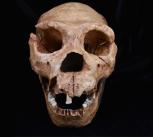
A cast of the skull of Homo Heidelbergensis, one of the hominin species analysed in the latest study.

Interspecies competition led to even more forms of ancient human – defying evolutionary trends in vertebrates

17 Apr 2024
Competition between species played a major role in the rise and fall of hominins, and produced a “bizarre” evolutionary pattern for the Homo lineage.
Read more
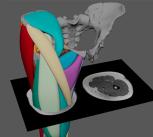
A cross-section of the polygonal muscle modelling approach, guided by muscle scarring and MRI data.

First hominin muscle reconstruction shows 3.2 million-year-old ‘Lucy’ could stand as erect as we can

14 Jun 2023
Digital modelling of legendary fossil’s soft tissue suggests Australopithecus afarensis had powerful leg and pelvic muscles suited to tree dwelling...
Read more
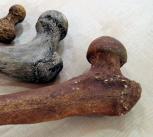
Femoral head bones of different hominin species. From top to bottom: Australopithecus afarensis (4-3 million years; ~40 kg, 130 cm); Homo ergaster (1.9-1.4 million years; 55-60 kg; ~165 cm); Neanderthal (200.000-30.000 years; ~70 kg; ~163 cm).

Height and weight evolved at different speeds in the bodies of our ancestors

08 Nov 2017
The largest study to date of body sizes over millions of years finds a “pulse and stasis” pattern to hominin evolution, with surges of growth in...
Read more
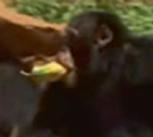
A chimpanzee moving bipedally during the study.

One step for early hominins: Study reveals why our ancestors switched to bipedal power

20 Mar 2012
Our earliest ancestors may have started walking on two limbs instead of four in a bid to monopolise resources and to carry as much food as possible in...
Read more
Subscribe to hominin

Connect with us

  • Facebook
  • Instagram
  • LinkedIn
  • X
  • YouTube
University of Cambridge

© 2026 University of Cambridge

  • Contact the University
  • Accessibility
  • Freedom of information
  • Privacy policy and cookies
  • Statement on Modern Slavery
  • Terms and conditions
  • University A-Z

Study at Cambridge

  • Undergraduate
  • Postgraduate
  • Lifelong learning
  • Courses in education

About the University

  • How the University and Colleges work
  • Give to Cambridge
  • Jobs
  • Map
  • Visiting the University
  • Cambridge University Press & Assessment

Research at Cambridge

  • Research news
  • About research at Cambridge
  • Public engagement